
Disturbing Facts About the Dancing Plague of 1518
FACTSFEATURED
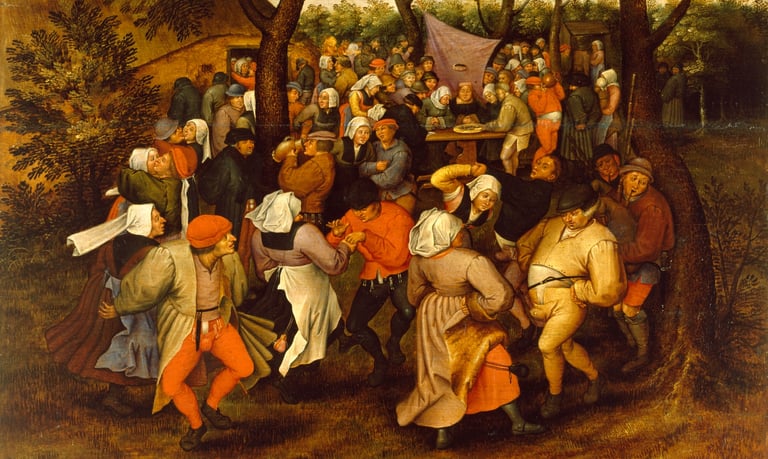
Whatever the cause, the Dancing Plague of 1518 was a truly bizarre and tragic event. It is a reminder of the power of the human mind, and the dangers of mass hysteria.
5 disturbing facts about the Dancing Plague of 1518:
It started with one woman
Every great disaster has a beginning, and for the Dancing Plague of 1518, the beginning was truly bizarre. The entire mass hysteria started with one single woman, known to history simply as Frau Troffea. On a hot day in July 1518, in the city of Strasbourg, Frau Troffea simply walked out into the street and began to dance.
She didn't stop.
For nearly a week, without music or rest, Frau Troffea danced until she was collapsing from exhaustion. This wasn't a cheerful jig; it was described as a frantic, uncontrolled spectacle. Imagine witnessing one person suddenly decide they cannot stop moving, their movements manic and desperate, not celebratory. The most disturbing fact is how quickly the contagion of movement spread from this sole individual. Within days, she was joined by handfuls of neighbors, and within a month, hundreds of people were involuntarily and relentlessly dancing in the streets of Strasbourg. This spontaneous solo performance was the terrifying ignition point for a deadly, mass hysterical nightmare.
Hundreds of people were affected
The sheer scale of the Dancing Plague is what catapulted it from a weird local curiosity to a historical nightmare. Once Frau Troffea had been dancing for a few days, she was not alone for long. She was soon joined by a few dozen neighbors who found themselves equally unable to stop moving. By the time the plague peaked in August 1518, historical records indicate that upwards of 400 people were seized by this bizarre, uncontrollable urge to dance in the streets of Strasbourg.
Imagine a major city square filled with hundreds of people, all moving relentlessly, day and night, in a shared, desperate frenzy. Witnesses described them weeping, screaming, and pleading for help, yet utterly unable to stop their frantic movements. The disturbance was so massive that authorities initially thought the best way to deal with it was to give the dancers more space to dance it out. This incredible escalation highlights the power of social contagion or mass psychogenic illness; one person's affliction quickly became a major public health crisis involving hundreds of unwilling participants trapped in a shared, exhausting horror.
The dancing was often violent
When you hear the phrase "Dancing Plague," you might picture a strange, but harmless, medieval flash mob. The reality was much more terrifying. The dancing that seized these hundreds of people was not joyous or coordinated; it was often described as manic, uncontrolled, and severely violent.
The dancers would leap, convulse, shake, and writhe, often crying out in pain or begging for the ordeal to stop, yet unable to command their own bodies. Many fell and were trampled, and they frequently injured themselves by twisting their limbs or violently striking solid objects. They weren't moving to music; they were thrashing. This violent, painful movement is the strongest evidence suggesting the plague was a form of mass psychogenic illness, or mass hysteria, possibly triggered by severe psychological stress, famine, and religious fear. The "dancing" was the agonizing physical manifestation of a profound mental and emotional breakdown shared by an entire community.
There is no known cause
Five centuries later, historians and scientists still cannot definitively point to a single cause for the Dancing Plague of 1518, which is perhaps the most disturbing fact of all. This wasn't some minor local panic; it was a well-documented event that led to mass casualties, yet its roots are lost to time.
Numerous theories have been proposed. One of the oldest and most discredited theories involved Ergotism, poisoning from a fungus on rye that causes spasms and delirium; however, the lengthy, weeks-long dancing fits don't quite match the symptoms of ergot poisoning. The most widely accepted modern theory is Mass Psychogenic Illness (MPI), or mass hysteria. The people of Strasbourg in 1518 were suffering from intense famine, crushing poverty, and widespread disease. The extreme psychological stress of their lives might have created a collective mental breaking point, manifesting as involuntary, relentless physical movement. But because we can't fully replicate or test the conditions, the terrifying truth remains: we don't know exactly what made hundreds of people dance to their deaths.
The dancing was seen as a sign of divine punishment
In 16th-century Europe, when faced with an inexplicable crisis like hundreds of people uncontrollably thrashing in the streets, the first place authorities looked for an explanation was the divine. The church and many local citizens didn't view the plague as an illness; they viewed it as a sign of divine punishment.
Specifically, it was believed that the dancers were being afflicted by a curse sent by Saint Vitus, the patron saint associated with dance and nervous disorders. The authorities' initial response to this crisis, based on this religious belief, was incredibly counterintuitive and disturbing. Instead of quarantining the afflicted, the Strasbourg officials decided the best remedy was to encourage the dancing. They cleared town squares, erected stages, and even hired musicians, believing that if the dancers simply exerted themselves enough, the divine punishment would exhaust itself and lift. This officially sanctioned, mandatory "treatment" only exacerbated the problem, leading to more exhaustion, more collapses, and ultimately, more deaths. It’s a tragic historical example of a bizarre phenomenon being met with an even more bizarre and deadly solution.

The Dancing Plague of 1518 remains one of the most compelling and profoundly unsettling chapters in human history. We've seen how it started with a single, desperate woman and spiraled to include hundreds of people, turning a major city into a stage for relentless, violent, and fatal movement. Add to this the fact that the authorities encouraged the outbreak as a form of "divine treatment," and the entire event reads like a dark satire.
This bizarre event reminds us how fragile the line is between physical illness and mental anguish. Whether it was the ultimate expression of mass hysteria triggered by starvation and stress, or some still undiscovered external cause, the story of the Strasbourg dancers is a chilling historical anomaly.
It stands as a testament to the idea that sometimes, the collective human mind can become its own worst enemy, forcing people to literally dance to death. The next time you hear a catchy tune, be thankful your dancing is strictly optional.