
Elon Musk's Groundbreaking Inventions and Companies
FACTSFEATURED
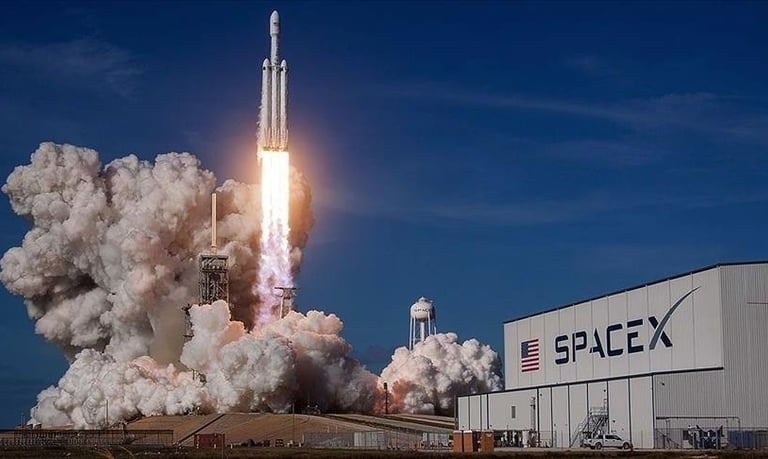
SpaceX is an American aerospace manufacturer and space transport services company headquartered in Hawthorne, California. It was founded in 2002 by Elon Musk with the goal of reducing the cost of space transportation and enabling the colonization of Mars.
Elon Musk's 5 Most Notable Inventions
These are just a few of the many inventions with which Elon Musk has been involved.
1. Tesla Motors
While Elon Musk wasn't technically one of the two founders of Tesla, he arrived early, took charge, and turned it into the electric vehicle (EV) powerhouse it is today. Tesla is probably Musk's most mainstream invention because it managed to do something nobody thought possible: make electric cars cool. Before the Tesla Roadster and the later Model S, electric cars were often seen as glorified golf carts, slow, boxy, and something your quiet aunt drove to the library.
Musk's genius wasn't just in the engineering (though the massive battery packs and powerful motors are impressive); it was in the branding. He took EVs, gave them neck-snapping acceleration, sleek designs, and the kind of high-tech screens that make a fighter jet look analog. He turned them into status symbols. By proving that EVs could be fast, desirable, and capable of long-range travel, Tesla fundamentally forced every single traditional automaker on the planet to pivot, accelerating the entire world's shift away from gasoline. Love him or hate him, Musk made the electric car the unavoidable future of transportation.
2. Space Exploration Technologies (SpaceX)
If Tesla is Musk's mission to save Earth, then SpaceX is his mission to give us a backup address. Founded in 2002, the entire premise of SpaceX was to do what NASA and huge government agencies couldn't or wouldn't do: dramatically reduce the cost of space travel and, eventually, make humanity a multiplanetary species.
The key invention here is the reusable rocket. Before SpaceX, launching a rocket was like using a very expensive, very fast car once and then throwing the whole thing away. It was incredibly wasteful. SpaceX mastered the delicate, balletic feat of having the first stage of the rocket, a massive column of metal, engines, and fuel, land itself vertically back on a tiny barge in the ocean. This single innovation fundamentally changed the space industry, making launches exponentially cheaper. It sounds like science fiction, but Musk basically made the space shipping industry competitive, paving the way for everything from Starlink internet to the ultimate goal: putting boots on Mars.
3. PayPal
Long before he was launching cars into space or building tunnels under LA, Elon Musk was battling to define the future of digital finance. His company, Xcom, which he founded in 1999 with the vision of being an online financial superstore, eventually merged with a competitor named Confinity. The merger was messy, the internal politics were brutal, but the result was the company we know today: PayPal.
Musk’s major contribution was the aggressive vision of digital money transfers. He believed deeply in the ability to move cash instantly and seamlessly over the internet, a concept that was genuinely radical at the time. While he famously wanted the merged company to keep the Xcom name, the rival side eventually won and rebranded it PayPal. This early win established a crucial pattern for Musk: identify a bottleneck in a traditional industry and relentlessly pursue a digital solution. When eBay bought PayPal in 2002, Musk walked away with a massive payout that directly funded the creation of his next, far more ambitious ventures, SpaceX and Tesla. You could say that every reusable rocket launch today is indirectly powered by the simple act of emailing money.
4. SolarCity
SolarCity, founded by Elon Musk's cousins Lyndon and Peter Rive, was based on an initial concept and capital provided by Musk, who served as its chairman. While the company didn't invent the solar panel, its primary innovation was its business model: it pioneered the idea of the solar lease and Power Purchase Agreements (PPAs) that allowed homeowners to install solar panels for no upfront cost. By removing the huge initial investment barrier, SolarCity rapidly became the leading residential solar installer in the US.
The true invention Musk sought came when Tesla acquired SolarCity in 2016. The goal was to create the world’s first truly vertically integrated sustainable energy company, combining electric cars, battery storage (Powerwall), and energy generation (SolarCity). This merger birthed the Solar Roof, an ambitious product designed to look exactly like a normal, beautiful roof tile but secretly generates electricity. Instead of ugly panels bolted onto your shingles, you get a seamless, aesthetically pleasing solar energy system. This integration of style, generation, and storage is the ultimate Musk-like invention: a complete, futuristic, and beautiful solution to a massive global problem.
5. Neuralink
If reusable rockets and electric cars seem tame, then Neuralink is where Elon Musk goes full cyberpunk. Founded in 2016, Neuralink is a neurotechnology company working on high-bandwidth brain-computer interfaces (BCIs) that are surgically implanted into the brain. Essentially, they are trying to sew a tiny chip into your skull that can communicate wirelessly with your phone or computer using nothing but thought.
The initial, noble goal is purely medical: to restore mobility, vision, and communication to people with severe paralysis or neurological disorders. Imagine someone unable to move being able to control a cursor or a robotic arm simply by intending to move their own hand—that's the life-changing potential. The innovation here lies in the ultra-thin, flexible electrode threads that get "sewn" into the brain by a specialized surgical robot, allowing for far more precise data collection than previous rigid implants. The big picture, however, is pure Musk: he believes this technology is necessary to create a symbiosis between humans and artificial intelligence (AI), ensuring we don't get left behind when AI eventually takes over. It's the ultimate invention: a direct upgrade for the human operating system.
Tesla is an American electric vehicle and clean energy company based in Austin, Texas. It was founded in 2003 by Elon Musk, JB Straubel, and Martin Eberhard.
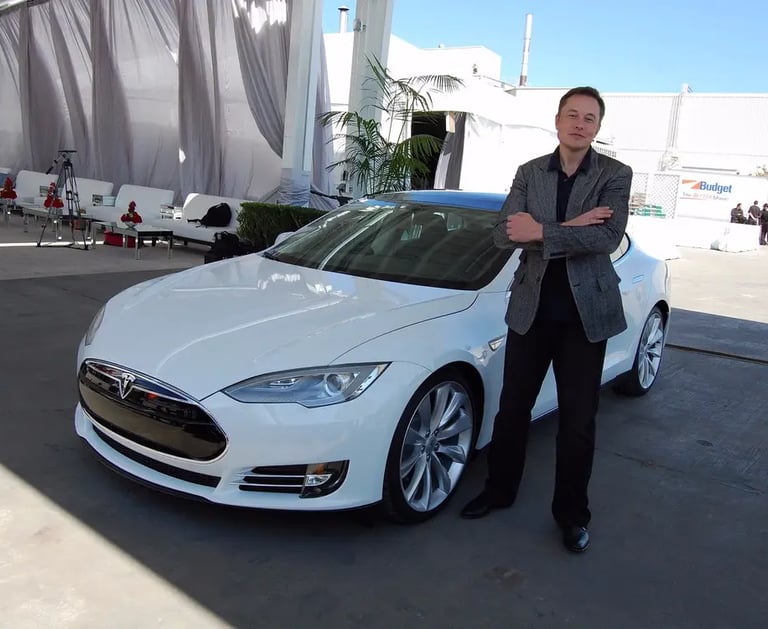

Five world-changing inventions from one man who clearly doesn't believe in taking a day off. We've gone from disrupting global finance with PayPal to disrupting global transport with Tesla, and then jumped straight into disrupting space with SpaceX and the planet's energy grid with SolarCity. And just when you thought things couldn't get more futuristic, he is attempting to upgrade the human mind itself with Neuralink.
Whether you see him as a brilliant visionary or a glorified hype man, the common thread in all these companies is a defiant, almost cartoonish ambition. Musk doesn't invent slightly better versions of things; he invents the infrastructure of the distant future. His inventions aren't just products; they are platforms designed to shift humanity away from combustion engines, away from Earth, and eventually, away from our biological limitations.
It's a dizzying portfolio that confirms one thing: Elon Musk’s true invention isn't any single car or rocket, but the relentless, sometimes chaotic, pursuit of the impossible.